
The ISURLOG (2026) IoT datalogger takes a qualitative leap in its design by adding support for non-rechargeable lithium thionyl chloride (LiSOCl2) batteries, expanding its operational capabilities in the field and drastically reducing the maintenance burden.
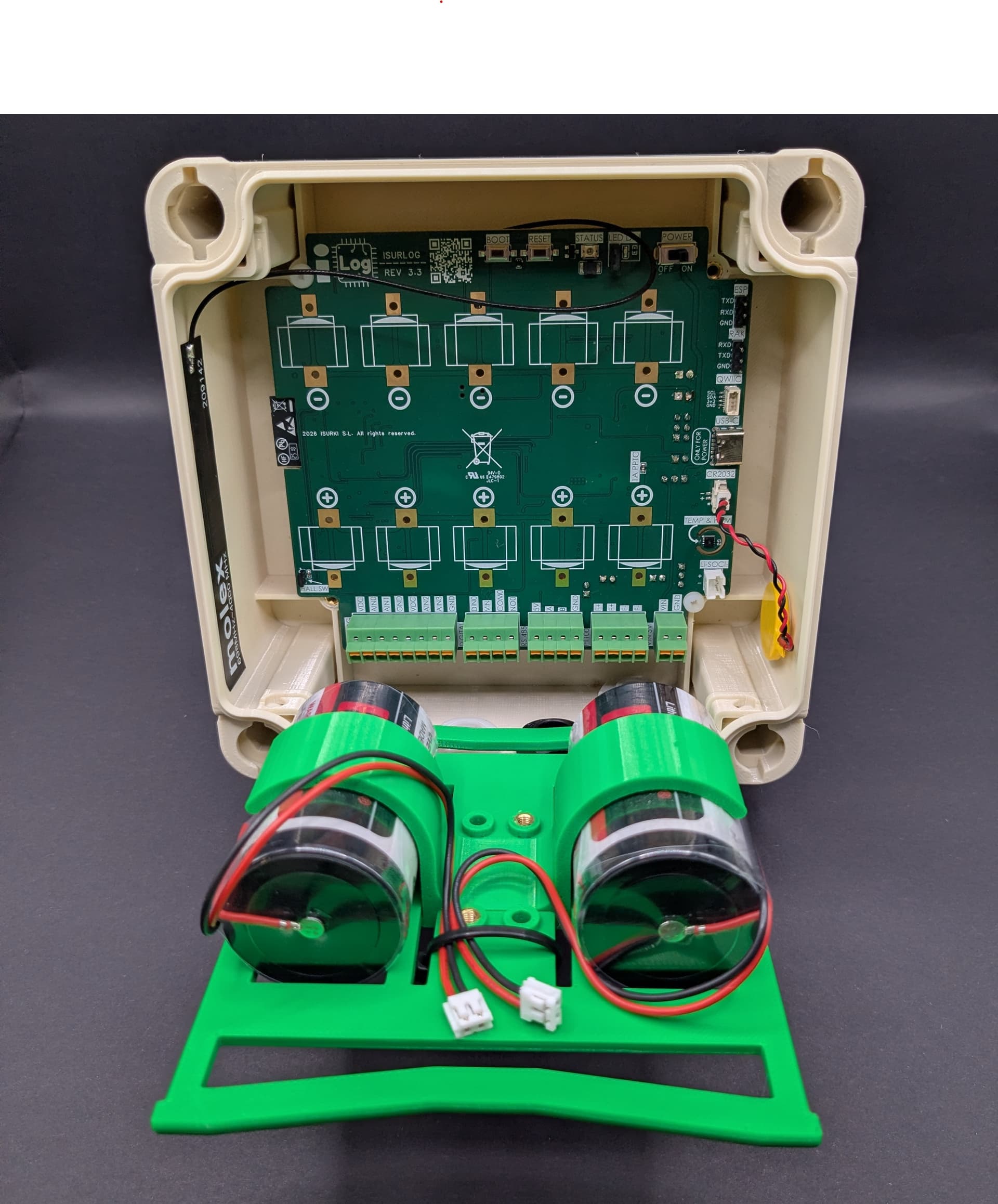
This hardware update allows two 19 Ah LiSOCl2 batteries to be fitted, reaching a total capacity of 38 Ah. Compared with the previous configuration based on 5 NCR18650B lithium-ion cells (3400 mAh per cell, 17 Ah in total), the new option not only more than doubles the available energy density, but also drastically optimizes charge retention in long-term deployments.
1. Main technical improvements
- Greater storage capacity: a direct increase from 17 Ah to 38 Ah, which multiplies the periods of continuous operation without needing to replace the power source.
- Minimal self-discharge: LiSOCl2 chemistry reduces the rate of charge loss to 1% per year, compared with the 1% per month typical of traditional lithium-ion cells. This ensures optimal operational stability in isolated or hard-to-reach nodes.
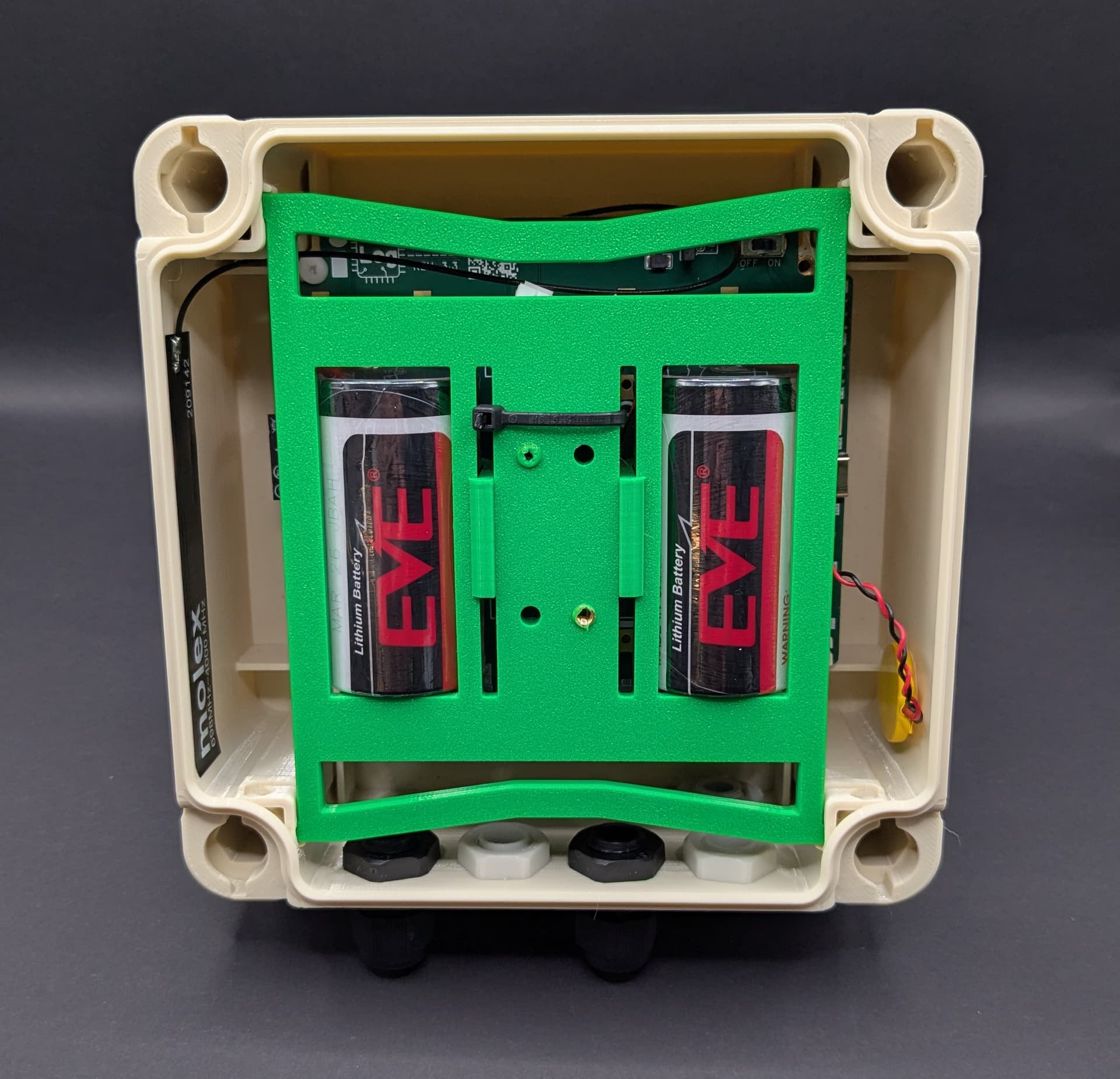
- Quick-mounting and maintenance system: a dedicated accessory has been designed that firmly secures the batteries to the ISURLOG housing. This mechanism protects the components against vibration and simplifies the field replacement procedure, reducing downtime.
2. Practical examples of increased field battery life
To illustrate the real-world impact of this improvement in a typical industrial monitoring scenario, let's consider two cases with the following working configuration:
| Case | Local data logging | Data upload to the cloud | Sensors considered |
|---|---|---|---|
| No. 1 | 15 min. | 3 hours | A 4-20 mA analog sensor powered directly from the ISURLOG at 12 V. |
| No. 2 | 5 min. | 1 hour | A Modbus flow meter with its own batteries, reading 3 parameters (instantaneous flow, accumulated flow, flow meter battery level). |
Under these two operating profiles, the battery life comparison is as follows:
| Battery configuration | Capacity | Annual self-discharge | Estimated battery life – Case No. 1 | Estimated battery life – Case No. 2 |
|---|---|---|---|---|
| Rechargeable Li-ion (NCR18650B) | 17 Ah | 12% | 1.6 years (19.3 months) | 1.4 years (17.1 months) |
| Non-rechargeable LiSOCl2 | 38 Ah | 1% | 3.9 years (46.4 months) | 3.4 years (40.9 months) |
Thanks to the combination of higher energy density and negligible self-discharge in LiSOCl2 cells, the ISURLOG makes it possible to extend preventive replacement cycles from a year and a half to almost four years of uninterrupted operation.
With this improvement, the ISURLOG strengthens its reliability in remote monitoring applications, offering a solution with greater energy durability and substantially lower operating costs for the supervision of industrial assets.